Investment in Stock Market

As I was a bit relaxed today, I decided to analyse my financial investments in Mutual Funds a bit deeper. As the stock market is making a very volatile trend, it also makes sense to check it regularly.
I am a member of valueresearchonline.com. It is oriented towards mutual funds in India and one can join it for free. It is an excellent source of research on mutual funds. For members, it offers a Portfolio Tracker as well as a Watchlist where one can track its choice of funds.
My portfolio consists of
  • ABN AMRO Opportunities Fund
  • Fidelity Equity Fund
  • Franklin India Prima
  • HDFC Taxsaver
  • Magnum Contra
  • Pru ICICI Taxplan
  • Reliance Equity
  • Reliance Growth
  • Sundram Midcap Select

So, I have added all these funds in my watch list as well. Besides, it has following funds as well:
  • HDFC Capital Builder
  • HDFC Equity
  • HDFC LT Advantage Fund
  • HDFC Top 200
  • Sundaram Growth
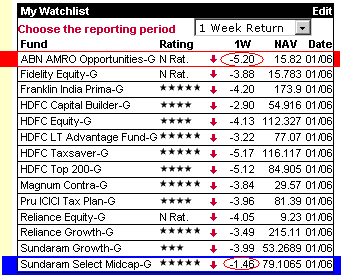
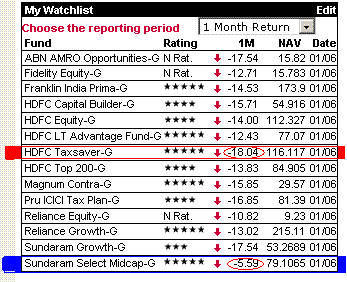
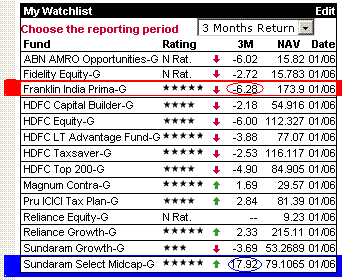
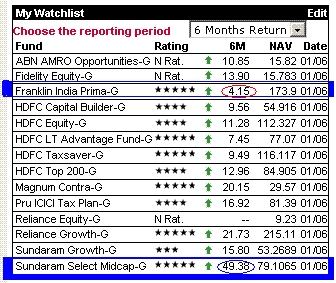
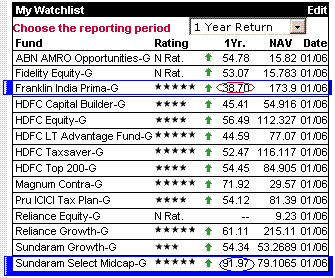
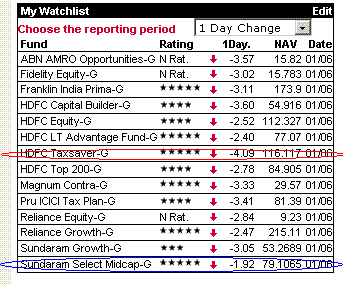
As I started comparing the returns of the funds over different period, I was amazed at the outcome. I compared for 1 day, 1 week, 1 month, 3 months, 6 months and 1 year, and I found one winner in all the periods :). but ,alas, other funds have not performed so well in these periods, especially since the downfall of the market started

I Day Change


1 Week Change
1 Month change


3 months change
6 Months Change
I Year change

The story about an Employee, an Organization and Money

When the very affable, 32 year old Priyanka snapped at Suryanarayan, the HR head, when the young 23 year old Arjun put in his papers, when the 48 year old accountant Paresh was rushed to the hospital with a mild heart attack – all these events happening during the normal working day, Suryanarayan did not see a pattern.

Prima facie there seemed to be no pattern to the three separate incidents. However, there was a connection.

Priyanka was going through a tough divorce. The bum she married was at last leaving her. But he was unemployed, and the house belonged to him. She had a job, a kid, and no house. Her parents were partially dependant on her. She was getting no alimony, there was no balance in the bank, and she was a financial mess.

Arjun had committed himself to some EMIs hoping for a decent raise. He was now paying off an education loan, a car loan, a vacation loan and an occasional credit card spend. Seeing the pattern of the past 2 years, he ‘assumed’ his raise would be Rs. 4,000 per month. It turned out to be Rs. 1,700 per month. Arjun was devastated. His immediate reaction was to find a new job. He had no clue where, how or when that new job would happen. He had no option of going back to the nest. His parents had smartly shifted to a smaller house to a the boomerangs. They did not want the kids coming back and eating into their nest egg. Very un-Indian thought Arjun, but that was the rule. Arjun was a financial mess.

Paresh was a very meticulous man and had nicely saved a lot of money. It was in safe avenues – post office, PPF, voluntary PF, National Savings Certificates and so on. He had a decent house, handed down by his father, and was financially well off. Well sort of. His spouse and three children were a source of joy only for the first few years of their lives. They had made him an ATM (automated teller machine) and made impossible demands on him. His eldest son had flunked college, trained as a cameraman spending Paresh’s money, had got married, and was unemployable. Paresh used all his resources but his two sons, one daughter, wife and an ailing mother had sapped him. He was underinsured, severely stretched, had no medical insurance. Paresh was a financial disaster.

When Surya saw the cases in detail and when the common thread running through them struck him, he asked himself a classic HR question:

When does the company step into the personal financial lives of its people?

He had no clear answer.

On a Thursday evening, finding his CEO (Chief Executive Officer) in a good mood, Surya brought up the question of the company’s role in the financial lives of its people. The CEO told Surya “Remember Gaurav Shah, our operations guy who joined a BPO? Last week he died of a heart attack. He was all of 38.”

The CEO was very clear that personal financial learning, stress busting, yoga and things that the employee needed should come from the employee’s own time and cost. He went on to add “Surya, we hire good, smart, aggressive guys who can bring business. If they are so smart, let them take care of themselves”. Surya felt a little defeated.

He thought to himself, “If 99% of my staff here is working for money, and I am willing to teach them how to talk, how to hold a fork and spoon, which hair oil to use when in USA, then how come I am not teaching them money management?”

He had no idea. One on hand, the CEO was right. As an organization, we provide employees with a regular income. Our role ends there. How they choose to use that income is their calling. They ought to take up responsibility for prudent financial management. But on the other hand, the incidents left a dent in the company’s HR policy. After all, whatever the reasons, high employee turnover was not healthy.

But by now it was 9 pm. He had to head home. Another 1-hour journey. But as he hit the car he thanked himself for one good decision. He now had a driver.

He sat down in the back seat and chuckled at his designation. He also remembered what his CEO told him “Do not ask me whether I have a heart. I don’t know. Ask my shareholders. They are Americans. Their lives and their dollars are measured by quarters…Q1, Q2, Q3, Q4. They look not beyond the short term”

His eyes closed. Jagjit Singh poured out his heart on the 5 track CD player. Tomorrow was another day.

Article courtsey MoneyControl.com
Salary Negotiation

Salary negotiation is one of the most delicate parts of the whole job search process, and it is at this stage that many candidates inadvertently disqualify themselves. At some point in the interview process, you will be asked, "How much do you want?" What they are, in effect, asking you is, "What do you think you are WORTH?" Or, put another way, "Do you have delusions of grandeur (or no self-confidence), are you going to be impossible to control, or are you a total wimp that I can micro-manage into an early grave?"...

How to Spin a Pencil Around Your Thumb

Have you ever watched somebody in class or at the office skillfully twirl a pencil around his or her thumb and wondered how that person did it? Have you tried to do it on your own and found that it's not as easy as it looks? By following these steps and practicing - a lot - you can amaze curious onlookers with your brilliant pencil spinning, too!

Who Packed Your Parachute

Charles Plumb, a US Naval Academy graduate, was a jet pilot in Vietnam. After 75 combat missions, his plane was destroyed by a surface-to-air missile. Plumb parachuted into safe hands. He survived the ordeal and now lectures on lessons learned from that experience.
One day, when Plumb and his wife were sitting in a restaurant, a man at another table came up and said, "You're Plumb! You flew jet fighters in Vietnam from the aircraft carrier Kitty Hawk. You were shot down!"
"How in the world did you know that?" asked Plumb.
"I packed your parachute," the man replied.
Plumb gasped in surprise and gratitude. The man grabbed his hand and said, "I guess it worked!"
Plumb assured him, "It sure did. If your chute hadn't worked, I wouldn't be here today."
Plumb couldn't sleep that night, thinking about that man. Plumb kept wondering what the man might have looked like in a Navy uniform. He wondered how many times he might have seen him and not even said good morning, how are you or anything, because you see, he was a fighter pilot and the man was just a sailor. Plumb thought of the many hours that sailor had spent in the bowels of the ship, carefully weaving the shrouds and folding the silks of each chute, holding in his hands each time the fate of someone he did not know.

Now Plumb asks his audience, "Who is packing your parachute?" Everyone has someone who provides what they need to make it through the day. Plumb also points out that he needed many kinds of parachutes when his plane was shot down. As you go through your week, month, and even New Year, recognize the people who have packed your parachute and enabled you to get where you are today!

Sometimes in the daily challenges that life gives us, we miss what is really important. We may fail to say hello, please, thank you, congratulate someone on something wonderful that has happened to them, give a compliment, or just do something nice for no reason.

[Received in a n email]